


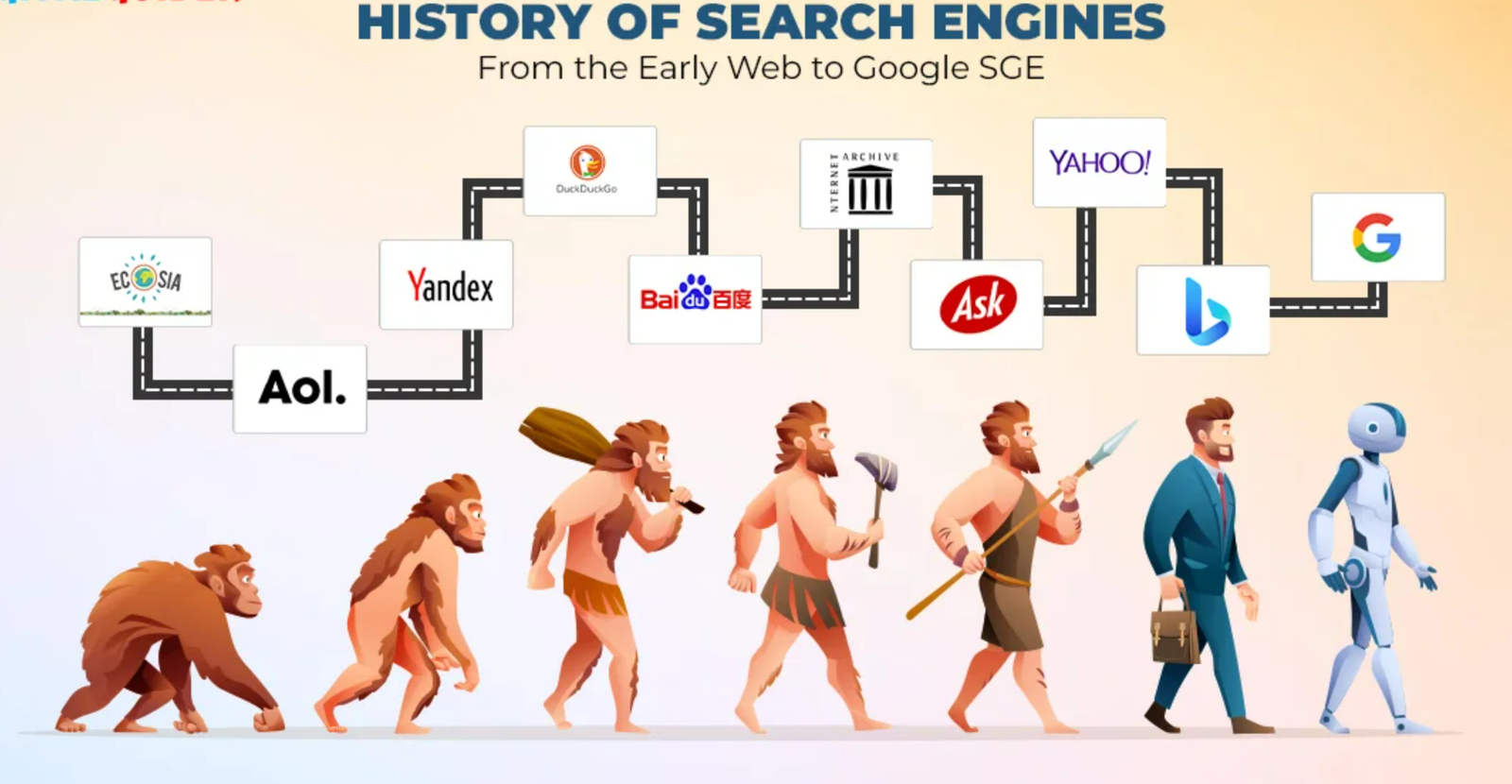
Search engines and artificial intelligence have evolved together to shape how information is discovered online. In the early internet era, search engines relied on simple keyword matching. Today, advanced artificial intelligence systems analyze context, intent, and behaviour to deliver highly relevant results. Understanding the full history from early search engines to modern AI-driven algorithms helps website owners, marketers, and SEO professionals build strategies that align with how search technology works today.
This article provides a comprehensive timeline covering the evolution of search engines, major algorithm updates, and the role artificial intelligence has played in shaping modern search.
The Early Days of Search Engines (1990–1997)
The first internet search tools appeared when the web started expanding rapidly in the early 1990s. One of the earliest search systems was Archie, created in 1990 to index files on FTP servers.
As the web grew, more powerful search engines emerged:
- WebCrawler (1994) – one of the first full-text web search engines
- Lycos – introduced faster indexing and ranking
- AltaVista – known for advanced search capabilities
- Yahoo! Search – initially began as a directory of websites
These systems relied heavily on keywords and metadata. However, as websites increased, results became cluttered with spam and low-quality content.
The Birth of Google and PageRank (1998)
In 1998, Google was launched by Larry Page and Sergey Brin.
Google introduced the PageRank algorithm, which ranked pages based on backlinks and authority rather than simple keyword frequency. This innovation dramatically improved search result quality and quickly made Google the leading search engine worldwide.
PageRank became the foundation of modern SEO, emphasizing the importance of link building and website authority.
Major Google Algorithm Updates (A–Z Timeline)
Google continuously updates its search algorithm to improve results and eliminate spam. Below is a chronological overview of the most influential updates.
Florida Update (2003)
The Google Florida Update was the first major algorithm change that targeted keyword stuffing and manipulative SEO practices.
Many websites using aggressive optimization techniques suddenly lost rankings. This update forced SEO professionals to adopt more natural optimization methods.
Jagger Update (2005)
The Google Jagger Update focused on improving link quality and detecting unnatural backlinks. Link farms and spammy directories were heavily penalized.
Big Daddy Infrastructure Update (2006)
The Google Big Daddy Update improved Google’s indexing system and helped handle duplicate content issues more effectively.
Caffeine Update (2010)
The Google Caffeine update introduced a new indexing system that allowed Google to index content much faster. This change enabled real-time updates and improved search freshness.
Panda Update (2011)
The Google Panda targeted low-quality content and content farms.
Sites with duplicate, thin, or poorly written content experienced ranking drops. This update pushed website owners to focus on high-quality, valuable content.
Penguin Update (2012)
The Google Penguin focused on spammy link-building techniques.
Websites using paid links, link networks, and unnatural backlinks were penalized. This update changed how SEO professionals approached link building.
Hummingbird Update (2013)
The Google Hummingbird introduced semantic search, allowing Google to understand the meaning of queries instead of simply matching keywords.
This update improved conversational search and long-tail queries.
Pigeon Update (2014)
The Google Pigeon improved local search results and connected them more closely with traditional web ranking signals.
Local businesses began benefiting from better location-based search accuracy.
Mobile-Friendly Update (2015)
The Google Mobile-Friendly Update prioritized websites optimized for smartphones and tablets.
Websites without responsive design lost visibility in mobile search results.
RankBrain (2015)
The Google RankBrain was one of the first AI-powered components integrated into Google’s algorithm.
It uses machine learning to interpret unfamiliar search queries and deliver more accurate results.
Artificial Intelligence in Search
AI has become central to modern search engines. Instead of simply indexing keywords, AI systems analyze context, intent, and language patterns.
Major AI developments in search include:
BERT (2019)
The Google BERT update improved Google’s ability to understand natural language queries.
BERT analyzes words in relation to other words within a sentence, allowing search engines to interpret context more effectively.
MUM (2021)
The Google MUM algorithm can process information across multiple languages and formats, including images and text.
It allows Google to answer complex queries that previously required multiple searches.
AI-Powered Search Experiences
Modern search now includes AI-generated summaries, voice search, and predictive search features. These systems use deep learning models to understand human language more naturally.
AI technologies used in search include:
- Natural language processing
- Machine learning
- Neural networks
- Large language models
Other Major Search Engines
Although Google dominates global search, several other platforms are important in the search ecosystem.
Microsoft Bing
Microsoft Bing integrates AI-powered features and is widely used within Microsoft products.
DuckDuckGo
DuckDuckGo focuses on user privacy and avoids tracking personal search behaviour.
Baidu
Baidu dominates the Chinese search market and supports millions of daily users.
Modern SEO in the AI Era
Search engine optimization has changed dramatically over the years. Today’s SEO focuses on:
- High-quality, helpful content
- User intent optimization
- Page speed and mobile experience
- Authority and trustworthy backlinks
- AI-friendly structured content
Websites that provide genuine value and strong user experience are more likely to rank well.
The Future of Search Engines and AI
The future of search will likely involve even deeper integration with artificial intelligence. Emerging trends include:
- AI-generated search results
- Conversational search interfaces
- Voice and visual search
- Personalized search experiences
- AI assistants integrated into search engines
Search engines are moving toward answer engines, where users receive direct, contextual responses rather than simple lists of links.
Major AI Updates in Search Engines (2022–2026)
Artificial intelligence has become the driving force behind modern search engines. Over the last few years, search platforms have rapidly integrated advanced AI models to improve understanding of user intent, generate answers, and provide more conversational search experiences. From 2022 to 2026, several major AI updates have reshaped how search engines work and how SEO strategies must adapt.
Below is a year-by-year overview of the most important AI developments in search.
AI Updates in 2022
Helpful Content System
In 2022, Google introduced the Helpful Content System, an AI-driven ranking signal designed to reward content written primarily for people rather than search engines.
Key goals of this update included:
- Reducing low-value SEO-only content
- Prioritizing informative and useful articles
- Identifying content created mainly for ranking manipulation
The system evaluates entire websites rather than just individual pages.
Multitask Unified Model Expansion
Another major development was the continued expansion of Google MUM.
MUM is an advanced AI system capable of understanding information across:
- Multiple languages
- Text and images
- Complex search queries
This allowed search engines to answer complicated questions using multiple data sources.
AI Updates in 2023
AI-Powered Search Experiences
In 2023, Google introduced Search Generative Experience (SGE), an experimental feature that uses generative AI to provide summarized answers directly in search results.
This feature allows users to:
- Receive AI-generated summaries
- Ask follow-up questions
- Get contextual recommendations
SGE marked a shift from traditional search results toward AI-powered answer engines.
Growth of AI Chat Technologies
The release of ChatGPT by OpenAI accelerated the adoption of conversational AI across the internet.
Search engines began integrating chatbot-style interfaces that allow users to interact with information more naturally.
AI Updates in 2024
AI Overviews in Search
In 2024, Google expanded AI-generated summaries directly into search results with AI Overviews.
These summaries use advanced language models to:
- Analyze multiple sources
- Provide quick explanations
- Suggest related questions
AI Overviews significantly changed how users interact with search results because they often deliver answers without requiring users to click multiple links.
Continued Language Model Improvements
AI models based on advanced transformer architecture improved significantly in 2024. These improvements enhanced:
- Context understanding
- Multilingual search capabilities
- Long-form content interpretation
Search engines became better at understanding the intent behind complex queries.
AI Updates in 2025
Advanced AI Ranking Signals
By 2025, AI systems became deeply embedded in ranking algorithms. Search engines increasingly used machine learning to evaluate:
- Content originality
- Author credibility
- User engagement signals
- Topic expertise
These systems help detect AI-generated spam and low-quality content.
AI Content Detection and Quality Signals
To combat mass automated content production, search engines enhanced systems that evaluate:
- Content authenticity
- Writing quality
- Topical authority
Websites producing helpful, expert-level content gained stronger rankings.
AI Updates in 2026
Fully Integrated AI Search Assistants
In 2026, search engines are moving toward fully integrated AI assistants that provide conversational answers within search interfaces.
These systems combine:
- Natural language processing
- Real-time data analysis
- Personalized recommendations
AI assistants can now help users complete complex tasks such as research, product comparisons, and travel planning directly within search results.
Multimodal AI Search
Modern AI search systems can process multiple content formats simultaneously, including:
- Text
- Images
- Audio
- Video
This allows users to perform visual search or ask questions about images and videos.
How AI Updates Impact SEO
AI-driven search algorithms have significantly changed SEO strategies. Modern SEO focuses on:
High-Quality Content
Search engines prioritize helpful and informative content that genuinely answers user questions.
Expertise and Authority
AI systems analyze whether content demonstrates expertise in a specific topic.
User Experience
Factors such as page speed, mobile design, and readability are increasingly important.
Intent-Based Optimization
Instead of focusing solely on keywords, SEO now focuses on understanding user intent.
The Future of AI in Search
AI will continue to transform how search engines work. Key trends expected in the coming years include:
- Fully conversational search engines
- Personalized AI assistants
- Voice and visual search expansion
- Real-time information synthesis
- Deeper integration of AI into everyday digital tasks
As search technology evolves, businesses and website owners must adapt by producing high-quality content that aligns with how AI systems evaluate information.
Between 2022 and 2026, artificial intelligence has fundamentally transformed search engines. Systems such as Google MUM and conversational technologies like ChatGPT have pushed search toward a more intelligent, interactive future.
For marketers and website owners, understanding these AI developments is critical. As search engines become more advanced, success in SEO will depend on providing valuable, trustworthy, and user-focused content that meets the expectations of both users and AI-powered search systems.
Conclusion
From early systems like Archie to advanced AI-powered platforms such as Google, search technology has undergone remarkable transformation.
Major updates like Google Panda, Google Penguin, and Google BERT have reshaped SEO practices by rewarding high-quality content and penalizing manipulative tactics.
As artificial intelligence continues to evolve, search engines will become even more intelligent, personalized, and efficient. For businesses and marketers, staying informed about search engine history and algorithm updates remains essential for long-term digital success.


0 Comments