

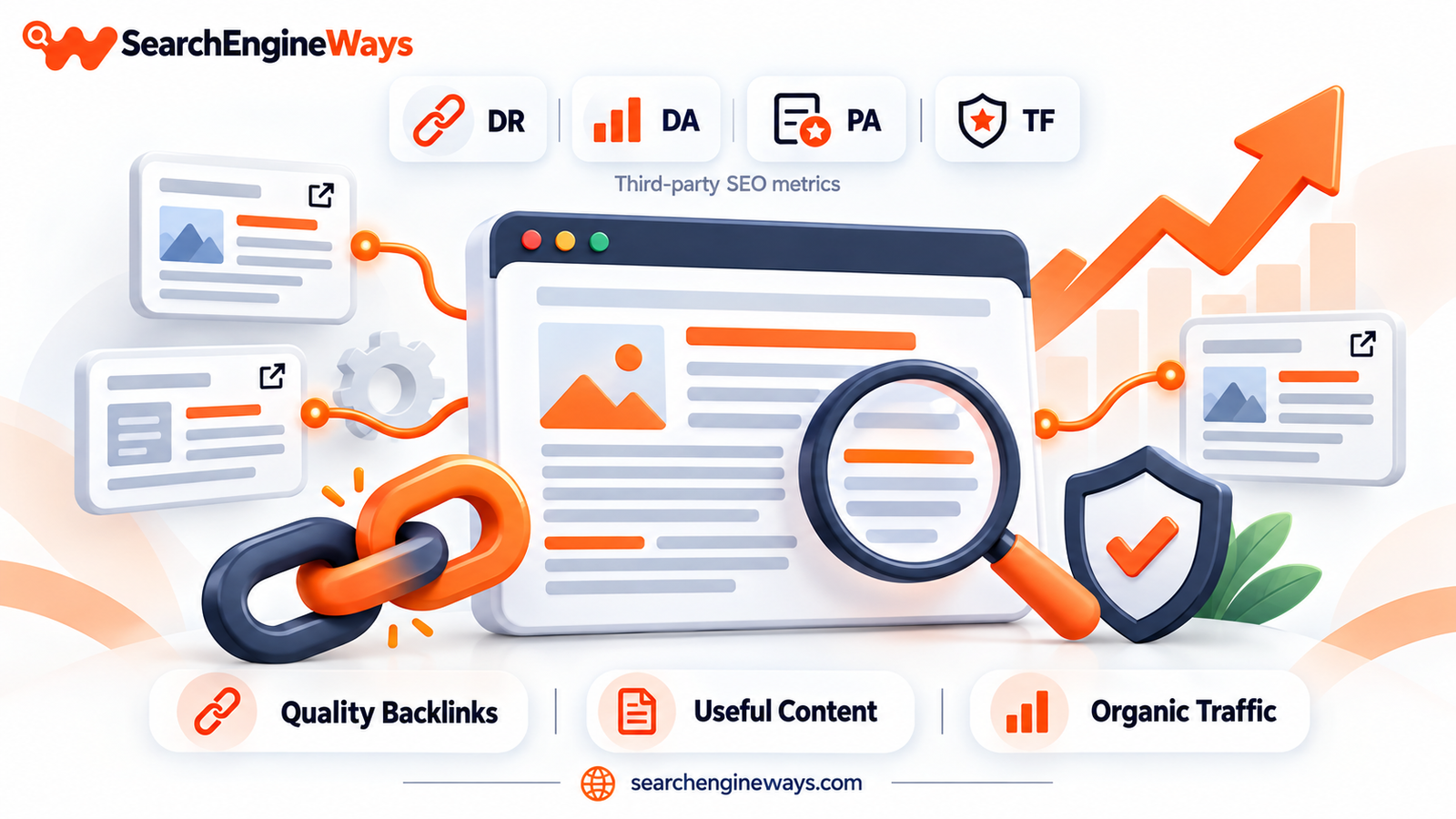
A website can gain authority scores without gaining customers. It can also increase organic traffic while its scores barely change. Understanding that difference is essential before investing in content, guest posting, digital PR, or link building.
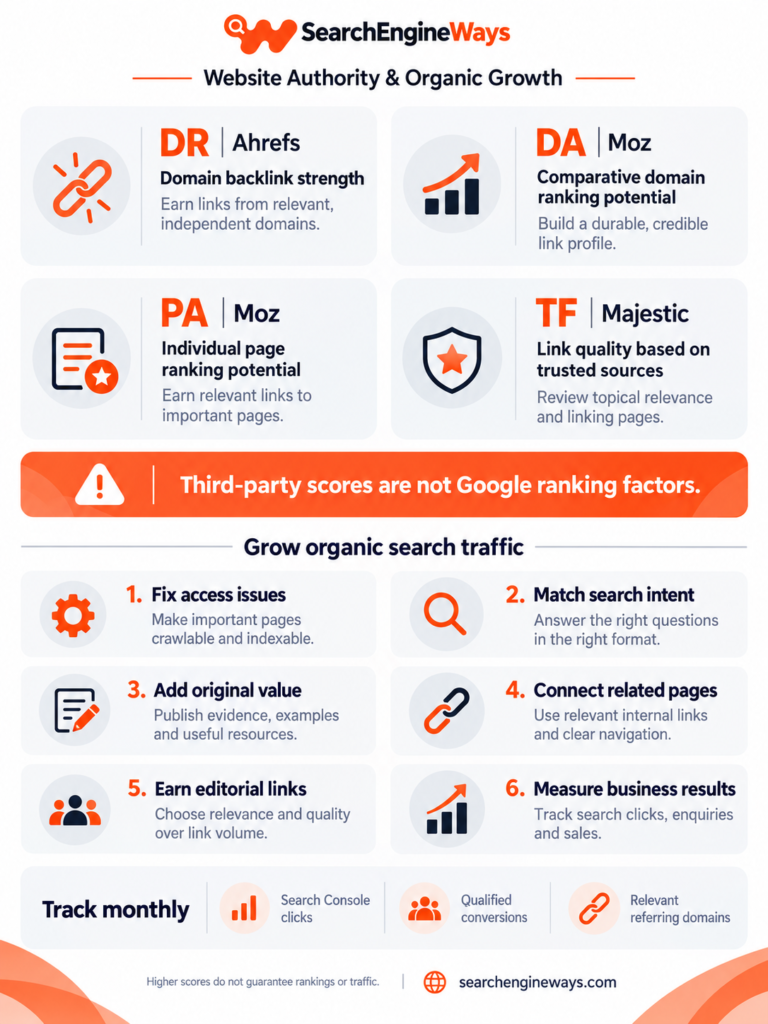
DR, DA, PA, and TF are third-party measurements, not Google ranking scores. They help evaluate link profiles and compare competitors. Google uses its own ranking systems, including page-level and site-wide signals. Increasing a vendor score does not automatically increase rankings or traffic. (majestic.com)
The following approach applies across many website types, but priorities depend on the business, competition, technical condition, and existing content. No method guarantees improvements for every website.
Download the complete research article with sources.
Start by understanding what each metric measures.
| Metric | Provider | What it measures | Main limitation |
|---|---|---|---|
| DR: Domain Rating | Ahrefs | Relative strength of a domain’s backlink profile | Does not measure content quality, customers, or Google rankings |
| DA: Domain Authority | Moz | Modeled ranking potential compared with other domains | A comparative prediction, not a Google authority score |
| PA: Page Authority | Moz | Link-based ranking potential of an individual URL | Does not establish whether the content satisfies a particular query |
| TF: Trust Flow | Majestic | Link quality modeled through connections to trusted seed sites | Not a Google trust score or definitive spam verdict |
| Organic search traffic | Search Console and analytics | Search clicks and attributable website visits, respectively | Does not explain performance changes without further analysis |
These providers use different datasets and calculations. DR 40, DA 40, and TF 40 are not equivalent. Compare the same metric, measurement scope, and reporting date. Do not combine them into an invented “Google authority” score. (Help Center – Ahrefs)
To improve DR, earn stronger referring domains.
Ahrefs’ DR calculation considers followed links between domains, the strength of linking domains, and how many other domains those websites link to. Additional links from one domain do not function like the same number of new referring domains. (ahrefs.com)
The practical priorities are:
- Earn editorial references from relevant, independent websites.
- Publish resources that other writers have a reason to cite.
- Recover valuable links lost through accidental URL changes.
- Evaluate the actual publication and linking page before considering its score.
- Track new and lost referring domains alongside important landing pages.
DR is logarithmic, so improvements become progressively harder higher up the scale. It can also change because the wider link graph changes, even when your website has not lost backlinks. There is no dependable formula such as “ten DR 70 links will add ten DR points.” (ahrefs.com)
Better writing can contribute indirectly by attracting references. Faster hosting can improve the visitor experience. Neither automatically becomes DR points.
To improve DA, develop a durable link profile.
Moz describes DA as a predictive model informed by link data. It is best used comparatively. A specialist business should compare itself with relevant search competitors rather than assume it needs the same score as a national publisher. (moz-static.s3.amazonaws.com)
Build your strategy around independent recognition: original research, useful industry resources, expert contributions, and legitimate business relationships.
Review the websites linking to competing pages. Ask what attracted those references. Was it a survey, a useful explanation, an original image, or a tool? Reproduce the underlying value, not the competitor’s article.
DA is not an examination grade. A score of 30 does not mean a website has completed 30% of SEO. Nor does a rising score prove that qualified traffic has increased. Provider index and model changes can affect scores, so interpret movement alongside business results. (moz-static.s3.amazonaws.com)
To improve PA, focus on individual pages.
PA evaluates a particular URL. Moz’s explanation describes it as link-based and distinguishes it from on-page optimization. A better headline may help search performance without directly changing PA. (moz-static.s3.amazonaws.com)
Choose the pages that matter commercially or editorially: service pages, product categories, research assets, and useful guides. Seek legitimate opportunities for those specific pages to earn references.
A campaign that attracts links only to the homepage may leave important internal pages with little direct external support.
Add relevant internal links from established content, and preserve valuable URLs during redesigns. When content genuinely moves, redirect it to the closest equivalent. Google treats permanent redirects as a strong canonicalization signal, but this does not guarantee an immediate ranking gain or fixed PA transfer. (developers.google.com)
Compare PA with pages competing for the same search intent. Comparing a detailed service page with another company’s homepage may be misleading.
To improve TF, examine the quality and relevance of connections.
Majestic’s Trust Flow models quality through a network connected to a curated seed set. Its calculations consider both internal and external links. Topical Trust Flow adds information about subject areas, while Citation Flow is more concerned with link influence driven by quantity. (majestic.com)
Use these measurements to investigate the sources behind a score. My recommendation is to prioritize topical fit, editorial standards, and a credible reason for the citation.
For example, a specialist engineering publication may be an appropriate prospect for an industrial supplier even if its scores are lower than a general entertainment website.
A gap between TF and CF can prompt investigation, but no universal TF/CF ratio proves that a website is safe or harmful. A low score alone is insufficient reason to reject a legitimate new publication or remove its link.
Establish traffic and business baselines before choosing score targets.
In Search Console, record clicks, impressions, CTR, and average position. Segment them by page, query, country, and device. This helps reveal which parts of the website are improving. (Search Console Help)
In analytics, record organic landing-page visits and meaningful actions, such as enquiries, purchases, bookings, or trials. Search clicks and analytics sessions are different measurements, so exact agreement should not be expected.
Also record vendor scores, referring domains, lost links, and priority URLs. Include year-over-year comparisons for seasonal businesses.
A useful goal is “increase qualified enquiries from these five service pages.” “Reach DA 50” can be a secondary benchmark, but it does not describe the business result.
Use the following patterns as investigation prompts:
| Observed pattern | Investigate first |
|---|---|
| Scores rise but clicks remain flat | Search demand, page relevance, indexing, and link destinations |
| Impressions rise but CTR falls | Query mix, ranking changes, search features, and title relevance |
| Clicks fall across many pages | Technical failures, seasonality, competition, and ranking updates |
| Traffic rises but enquiries do not | Visitor intent, location, offer clarity, forms, and measurement |
| One score falls while traffic remains stable | Lost links, provider recrawling, and relative-score changes |
Google recommends examining affected pages and queries, technical issues, demand changes, and update timing before making major changes. (developers.google.com)
Remove technical barriers before expanding promotion.
Google’s minimum technical requirements include crawl access, a successful HTTP response, and indexable content. Meeting these requirements establishes eligibility, not guaranteed indexing. (developers.google.com)
For important pages, investigate:
- Accidental
noindexdirectives. - Server errors and inaccessible content.
- Broken navigation and unexpected redirects.
- Pages missing from relevant internal links.
- Indexing settings inherited from staging environments or redesigns.
Use URL Inspection to examine representative pages rather than assuming every page behaves like the homepage.
For WordPress and WooCommerce, review settings introduced by SEO plugins, product filters, and category systems. Avoid blanket indexing decisions without understanding what each page contributes.
On ecommerce websites, make products reachable through category navigation. Google specifically recommends linked paths through categories to products, rather than depending entirely on an internal search box. (developers.google.com)
Choose topics where the website can satisfy real demand.
My recommended keyword process begins with customer questions and business priorities. Identify the reader’s task: learning, comparing, finding a local provider, or buying.
Next, inspect the current search results. Are searchers being served product categories, tools, tutorials, videos, or service pages? Use that evidence to choose the appropriate format.
Prioritize topics using:
- Business relevance.
- Evidence of demand.
- Existing search visibility.
- Competitive difficulty.
- Your ability to contribute useful information.
Keyword difficulty scores help screen opportunities, but they cannot replace reviewing competing pages.
For an agency, possible topics include evaluating guest-post prospects, auditing backlink relevance, documenting content improvements, and explaining digital PR costs. These are topic examples, not verified claims of low competition or search volume.
Create resources worth reading and referencing.
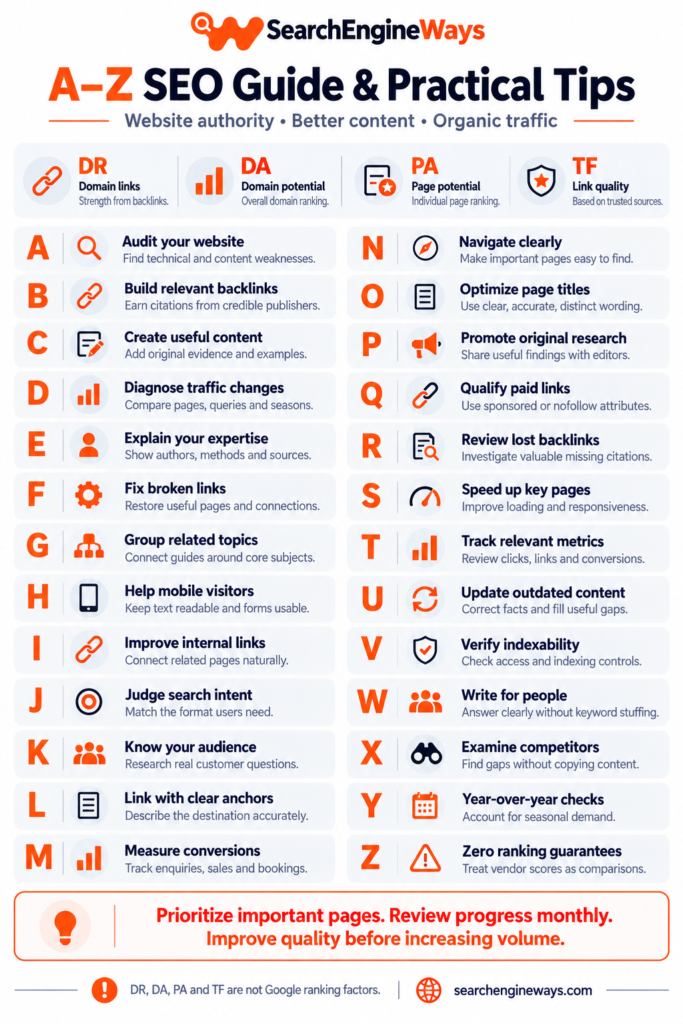
Google’s helpful-content guidance emphasizes original information, useful analysis, clear sourcing, and evidence of experience. Publishing more words or changing a date without improving the material does not establish quality.
Useful assets might include an original survey with a stated method, a calculator, a technical template, a tested tutorial, or a well-documented case study.
For example, SearchEngineWays could publish an analysis of outreach acceptance patterns using anonymized campaign data. Explain the sample, period, selection criteria, and limitations. This gives writers something specific to cite and potential clients evidence to evaluate.
My editorial test is: what can readers learn here that they cannot already learn from the existing results?
Demonstrate expertise through the work. Accurate author information and transparent methods support credibility, but adding an author box alone does not create authority. (developers.google.com)
Connect useful pages through internal links.
Google recommends descriptive, concise anchor text and crawlable links. Important pages should have links from elsewhere on the website. There is no universal ideal number of links per article. (developers.google.com)
For a content-writing service, connect the service page with relevant case studies, content-brief examples, and editing guides. Each connection should help someone take a useful next step.
Review pages that already receive external links and identify appropriate connections to related resources. Avoid linking every article to every service page.
Internal links support discovery and context. Their effect on vendor scores depends on the model; they do not create new external referring domains for DR.
Evaluate backlink opportunities beyond their scores.
Ahrefs itself recommends looking beyond site-wide authority, including content quality, topical relevance, traffic, and backlink characteristics. (Help Center – Ahrefs)
The following is a practical screening framework:
| Check | Stronger evidence | Reason for closer review |
|---|---|---|
| Relevance | Related publication and audience | Article unrelated to the readership |
| Editorial care | Clear authorship, sourcing, and useful material | Thin or repetitive articles |
| Link context | Destination supports the surrounding information | Commercial anchor forced into unrelated text |
| Search visibility | Plausible visibility for relevant topics | High scores with unexplained traffic anomalies |
| Ownership and history | Consistent purpose and identifiable operations | Abrupt topic changes or unclear control |
| Placement | A useful page readers can discover | An isolated page created to host links |
SEO-tool traffic estimates are directional, not audited analytics. A small specialist publisher can still be valuable. Apply the checks together instead of relying on one acceptance threshold.
Use outreach with an editorial purpose.
Recommended opportunities include sharing original findings with journalists, contributing genuine expertise, requesting attribution for correctly identified unlinked mentions, and suggesting useful resources to relevant editors.
Broken-link outreach is appropriate when your page genuinely replaces the missing resource. Partnership links should reflect real relationships. Guest articles should provide an independent contribution to the publication.
Payment changes the requirements. Google says paid placements should use appropriate qualifications, such as rel="sponsored" or rel="nofollow". Buying followed links to manipulate rankings, excessive exchanges, and automated link schemes can violate its spam policies. A high publisher score does not remove that risk.
A press release can support an announcement and attract coverage, but syndication across many websites should not be presented as equivalent to independent editorial endorsements.
Recover valuable links without indiscriminate cleanup.
Investigate whether important external links point to pages accidentally deleted or moved. Restore useful content when appropriate, repair internal links, and map genuine replacements carefully.
Do not automatically disavow websites because a tool labels them toxic. Google says most websites do not need the disavow tool and warns that misuse can harm performance. Its guidance concerns substantial artificial or low-quality link problems associated with an actual or likely manual action. (Search Console Help)
Separate a Google remediation decision from an attempt to change a third-party dashboard.
Improve the search listing and visitor experience.
Write titles that distinguish the page and address the reader’s task. Avoid repetitive boilerplate and keyword stuffing. Google generates title links automatically and may display wording different from the title element.
Assess CTR among comparable queries and positions. Lower site-wide CTR can reflect expansion into new searches rather than a weaker title.
Also review performance on real devices. Core Web Vitals cover loading, responsiveness, and layout stability. Useful targets include LCP within 2.5 seconds, INP around 200 milliseconds or better, and CLS around 0.1 or lower. These are experience benchmarks, not guarantees of higher rankings or authority scores.
Prioritize readable content, stable layouts, working forms, clear product information, and relevant next actions.
Adapt priorities to the website type.
| Website type | Content priorities | Promotion opportunities | Main business outcome |
|---|---|---|---|
| Local business | Genuine service and location information | Local coverage and relevant organizations | Qualified calls and bookings |
| Ecommerce | Product details, category navigation, buying guides | Product expertise and useful tools | Profitable organic sales |
| SaaS | Use cases, integrations, documentation, comparisons | Research and specialist communities | Qualified trials and demos |
| Agency or consultant | Service explanations, case studies, resources | Expert contributions and original research | Relevant enquiries |
| Publisher or blog | Reporting and maintained reference material | Specialist coverage and citations | Returning readers and subscriptions |
| New website | A focused set of useful, accessible pages | Genuine relationships and strong resources | Early qualified discovery |
These are recommended priorities, not guaranteed outcomes.
Local visibility additionally depends on relevance, distance, and prominence. Accurate Business Profile information and genuine reviews matter. Improving DR cannot change the searcher’s physical distance from a business. (Google Business Profile Help)
Account for AI search without chasing another score.
Google says established SEO practices remain relevant to AI Overviews and AI Mode. Supporting pages must meet indexing and snippet eligibility conditions. There is no specified DR, DA, PA, or TF threshold for appearing in these features.
Publish evidence readers can inspect: tested examples, explained methods, current details, and useful comparisons. Give visitors reasons to continue beyond a summary.
AI visibility and website visits are different outcomes. Record both where measurable, while keeping qualified traffic and business results central.
Organize implementation over 90 days.
This schedule is a planning framework, not a promise of results within 90 days.
| Period | Work | Reviewable output |
|---|---|---|
| Days 1–14 | Establish baselines; audit priority URLs, links, and competitors | Measurement sheet and prioritized issue list |
| Days 15–30 | Resolve critical access issues; improve important pages and internal links | Documented fixes and revised content |
| Days 31–60 | Publish a substantial reference asset and conduct relevant outreach | Published resource and prospect-quality records |
| Days 61–90 | Review performance, recover useful links, and refine priorities | Results analysis and next-quarter plan |
For a small team, one carefully researched resource and several meaningful page improvements may be more manageable than a large publishing quota. Increase output when research, editing, and maintenance capacity support it.
Google says some changes take effect quickly while others take months, and not every change produces a noticeable benefit. Vendor-score updates also follow their own discovery and processing schedules. (developers.google.com)
Review monthly performance in this order: qualified conversions, relevant organic clicks, priority-page visibility, retained editorial links, and vendor scores. Keep a dated change log and account for seasonality before attributing a gain to one backlink or edit.
For SearchEngineWays and its clients, the strongest report explains what improved, why it was prioritized, and what happened afterward. Present DR, DA, PA, and TF alongside those outcomes so the scores support business decisions.
0 Comments